Sunday, 12 July 2020

Comet C/2020 F3 (NEOWISE)...


Object: Comet C/2020 F3 (NEOWISE)
Type: Comet
Constellation: Lynx
Distance: 134 million miles
Date: July 11th. 2020
Equipment: ATIK 460EX with EFW2, Skywatcher f5.5 Esprit 100 ED refractor, Avalon Linear mount
Subframes: 10 x 60s and 3 x 120 sec each for luminance and RGB, stacked and colour combined in Astroart, final processing in PaintShop Pro

It was with faint optimism that I swung the telescope down to this target at the end of a long imaging session. Initially the scope was pointing at a hedge, but the comet soon cleared my local obstacles and starting at around 3 a.m, I rattled off some exposures before the comet was quickly drowned out by the brightening dawn twilight.


Mk1 NEOWISE image...
The subs were messy (to say the least!), full of weird gradients and blobs brought on by the rapidly changing twilight conditions and some local horizon objects crossing the field as the telescope tracked the comet.

I processed the one minute frames to give (after a lot of work) a cleanish image, but still plagued with psychedelic background colours (see opposite). I was going to leave it at that, but today I thought I'd layer in the sky background from my first image of this comet, plus some data from the 120 second subs which showed a hint of the blue ion tail. The eventual result is the main image above, which I'm rather pleased with...

This comet is probably the most striking since Hale-Bopp back in 1997. Recent infra-red studies show that NEOWISE's nucleus is quite large, at around 5 km in diameter, hence its brightness. Hopefully it will remain as bright as it moves into the south-western evening sky (at a more civilised time!) over the course of the next few weeks...

Moon...

Waxing gibbous Moon...
Object: Moon (77% of full)
Constellation: Aquarius
Distance: 399523 km (248252 miles)
Dates: 11th. July 2020
Equipment: ATIK 460EX with EFW2, Skywatcher f5.5 Esprit 100 ED refractor, Avalon Linear mount
Subframes: 100 x  H-alpha (0.001s)

From the same session as the previous image, this one also nearly didn't make it on screen. I thought I'd grab a few subs of the moon as an afterthought, so I just slewed the telescope from my previous target (NGC 6820) down to the moon, which was lurking low down in the sky at about 16 degrees above the south-eastern horizon.

I made the mistake of not checking the focus before acquiring the subframes, and no amount of messing around in Registax or PaintShop will ever get back that missing detail...

I've put the final image up anyway, if only as a reminder of my own carelessness.

Monday, 6 July 2020

Comet C/2020 F3 (NEOWISE)...

Comet NEOWISE...
Object: Comet C/2020 F3 (NEOWISE)
Type: Comet
Constellation: Auriga
Distance: 160 million miles
Date: July 6th. 2020
Equipment: Canon 450D, Vixen 600mm 114 ED refractor, GPDX mount
Subframes: 34 x 1 sec @ ISO400,  processed in Registax.


Comet C/2020 F3 NEOWISE’s unusual name comes from NASA's Near-Earth Object Wide-field Infrared Survey Explorer (NEOWISE), which discovered the comet on March 27, 2020.  It is a retrograde comet with a near-parabolic orbit.  It survived its closest approach to the Sun on July 3, 2020 at perihelion 0.29 AU (43 million km) from the Sun, some 14 million km closer on average than the planet Mercury, an encounter that causes many comets to disintegrate.  Solar heating of this ball of ice and rock subjected it to temperatures of nearly 600C, causing it to dramatically brighten and shed gas and dust, giving rise to a cometary tail.  

My image above gives a fair representation of what the comet looks like through 6 x 30 binoculars before the dawn twilight gets too bright. 

Closest approach to Earth will occur 23 July 2020 at a distance of 0.69 AU (103 million km). This perihelion passage will increase the comet's orbital period from about 4500 years to about 6800 years.

Originally, NEOWISE was not expected to get much brighter than ninth or 10th magnitude, making it accessible only to those with good binoculars or small telescopes. During the spring, observers in the Southern Hemisphere followed the very rapid brightening of this object as its distances from both the sun and Earth decreased.  A consensus of observations placed it at magnitude +9.9 on May 10. Just under a month later, on June 7, the comet was on the far side of the sun, 73 million miles (117 million km) distant from the star and 147 million miles (236 million km) from Earth. It had increased 12-fold in brightness to a magnitude +7.2. As projected on the sky, the comet was scarcely 24 degrees from the sun (a closed fist at the end of an outstretched arm covers 10 degrees of the sky) and the two were rapidly closing together. Shortly thereafter, the comet was lost to earth-based observers in the increasing glare of the sun.

From June 22 through to June 27 however, the comet was within the range of the Solar and Heliospheric Observatory (SOHO). SOHO is a cooperative mission between the European Space Agency (ESA) and NASA. The spacecraft is stationed in a halo orbit around the sun-Earth L1 Lagrangian point, a position roughly 930,000 miles (1.5 million km) sunward of Earth. At this point in space, the orbital period of SOHO exactly matches the orbital period of Earth. From this orbit, SOHO is able to observe the sun 24 hours a day.

Using its Large Angle and Spectrometric Coronagraph (LASCO-3, which uses an occulting disc to block out the glare of the sun's disc from its images), NEOWISE could be monitored as it passed near to the sun.  During this time, the comet appeared to significantly brighten, just before it passed out of the field of the LASCO-3 camera. Comet NEOWISE also appeared to have developed a rather bright, albeit short and stubby forked-shaped dust tail.

Comets fall into two categories. "Common" comets are faint fuzz-balls that are visible only with the help of good binoculars or telescopes. At any time there may be perhaps eight or 10 such comets in our sky. Then there are the "Great" Comets, those that become bright enough to be plainly visible with the naked eye and accompanied by a striking tail of dust and gas. Unfortunately, such objects do not come around very often. In the average human lifespan, you may get a chance to see perhaps four if you are very fortunate.

The last great comet visible from the Northern Hemisphere was Comet Hale-Bopp in 1997, but is NEOWISE developing into one right now? Based on the very latest brightness estimates, Comet NEOWISE might fall just short of the criteria, though once it becomes evident in darker skies it should be quite obvious, especially away from light polluted cities.

Catching this comet required an early morning start, to see it emerge above the horizon for about 40 minutes before the glare of the rising Sun drowns it out.  At 3.45 a.m. the comet was a mere 8 degrees above the horizon and had just got above the roof of my next door neighbour's house.

Position of Comet NEOWISE on the morning of July 6th. 2020
The chart opposite shows its position in the sky that morning.

I was able to rattle off about 40 exposures, with one second ISO 400 exposures seeming to offer the best contrast between the comet and the rapidly brightening morning sky. The comet, with just a hint of its tail, was just visible to the naked eye in the morning twilight, but only because I knew exactly where to look, thanks to a laptop looking after the telescope pointing!  Through small binoculars, the tail was very evident and the jets on either side of the comet head could be seen.

I estimated its magnitude to be around 2, though its low elevation in the morning twilight makes such assessments difficult. It is certainly the brightest comet I have seen in the UK since Comet 17P Holmes back in October 2009.

Over the next few weeks, the comet draws away from the Sun, becoming an early evening object towards the end of July (see chart below).  It will be interesting to see if NEOWISE continues to remain bright as it passes by the Earth.

Track of Comet NEOWISE during July in 2020.
References:

1)  https://en.wikipedia.org/wiki/C/2020_F3_(NEOWISE)

2)  https://www.space.com/comet-neowise-july-2020-night-sky-forecast.html

Tuesday, 23 June 2020

Messier 16: The Eagle Nebula...

M16: the Eagle Nebula...

Object: Messier 16 (NGC 6611: nebula catalogued as IC 4703, Sh2-49)
Type: Open cluster with nebula
Constellation: Serpens Cauda
Distance: 6,000 light years
Date: June 22nd. 2020
Equipment: ATIK 460EX with EFW2, Skywatcher f5.5 Esprit 100 ED refractor, Avalon Linear mount, guiding with Lodestar X2/PHD
Subframes: 12 x 300s Ha, 12 x 300s + 6 x 300s (2x2 binned) OIII, no flats/darks (hot pixel removal in Astroart).

The sixteenth entry in Charles Messier’s famous catalogue of deep sky objects has a long and interesting history. The star cluster itself was first discovered by Swiss astronomer Jean-Philippe de Cheseaux in 1745–46, and was subsequently “rediscovered” on June 3, 1764 by Messier (who listed it as M16 in his own catalogue).

Messier described M16 as a “cluster of faint stars mingled with faint luminosity” although it is not clear that he actually observed the nebula itself, as Messier often accredited star clusters with nebulosity (a product of the poor quality of his telescopes rather than his undoubted ability as an observer).

French astronomer Etienne Trouvelot subsequently observed the nebula and described it in detail (nicknaming it “the Fan”) prior to British astronomer Issac Roberts photographing it in 1894. 

For the IC catalogue, John Dreyer treated M16 as being primarily the cluster itself, listed it as NGC 6611, and added the IC entry for the nebula lit by the cluster.

M16 has had various popular monikers, but the “Eagle nebula” seems to have stuck (although I think Trouvelot’s name is the most sensible). The occasionally-used "Star Queen Nebula" was introduced by Robert Burnham, Jr., in his lyrical description of the object in his classic Celestial Handbook, reflecting his characterization of the central pillar as the "Star Queen", shown in silhouette. 

Location of image field, looking south on June 22nd
Messier 16 can be found in the constellation of Serpens Cauda, low in the southern mid-Summer sky from UK latitudes (see map opposite) where, on rare evenings, the faint glow of the centre of our Milky Way can be glimpsed. M16 is best seen visually in a low-powered, wide field telescope. 4-inch instruments will resolve about 20 stars against several regions of faint nebulosity. The brightest portion of the nebula (which I imaged back in 2006) spans about 20 arc-seconds (a bit less than the diameter of the full moon) although my latest image above shows that it is just the brightest part of a whole expanse of faint nebulosity lurking in the distant Sagittarius arm of our galaxy.

Unfortunately, the general public’s expectations of night sky observing have been raised by the Hubble Space telescope and its iconic images of the Pillars of Creation, and folk are often disappointed by the faint, monochromatic real life views of nebulae such as M16 through amateur telescopes

The pillared, dust-strewn heart of M16 is a stellar nursery, where stars are being born inside dense clouds of cold gas. The detailed Hubble images of several of these natal cocoons led to their naming as the “Pillars of Creation”. The images show these clouds bathed in intense ultraviolet light from M16’s cluster of young, massive stars, with jets of gas streaming off the pillars as the intense radiation heats and evaporates it into space. Denser regions of the pillars are shielding material beneath them from the powerful radiation.

Imaging from the Medway valley with a 4-inch refractor, one is at a slight disadvantage compared to the Hubble telescope. Instead of the vacuum of space, my telescope is attempting to peer through a haze of dust and light-polluted air, particularly as M16 never rises greater than 25 degrees above my southern horizon.  Also, at this time of year, the sky has no true astronomical darkness as the sun never sets more than about 14 degrees below the horizon, although to me the sky looked as dark as it ever does when I started out taking sub-frames at around 23.30 on a warm summer’s evening. 

Auto-guiding wasn’t brilliant given that I was trying to image through warm air low in the sky, but it was good enough.  The Ha data was reasonable and given that I only had about 3 hours of darkness to play with, I swapped over to gathering some OIII frames after I had a dozen Ha frames in the electronic bag. 

Whilst the true colour of deep sky celestial objects is a fairly subjective thing, I am no fan of the “Hubble pallet”, a colour scheme used by NASA to render its images (and which as a result is now fashionable with amateur astro-imagers) whereby H-alpha light is assigned to the green channel and S-II to the red, with OIII as the blue. 

To me, hydrogen emission nebulae should be red, not lurid psychedelic yellows, greens or blues.  However, the plethora of such images of M16 led me to expect a much stronger OIII signal than I was actually getting. Fortunately, I had logged on to Stargazers Lounge and was able to ask the question, with veteran astro-imager Carole Pope suggesting that I take 2x2 “binned” exposures (where four adjacent pixels are bulked together to act as one on the camera chip, increasing sensitivity and reducing background “noise”). I don’t like the way this sometimes makes smaller stars a bit blocky, but it seemed to work OK this time and I was able to grab a few brighter images before an owl sat on my telescope (I think!).

Earlier, when I walked down the garden slope to my observatory to set up, a barn owl had swooped just in front of me, a white flash in my head-torch light that had startled me no end.  I have been visited by the local tawny owls in the past and indeed, one had once flown into the open dome hatch while I was in the observatory, giving me another late-night heart attack experience.

On this occasion, I was keeping an eye on the equipment remotely via a Cat 6 cable link from the observatory lap-top to another indoors. Suddenly, the auto-guiding graph shot off-scale and I thought “cable snag”. I dashed down to the observatory, where everything fortunately seemed normal, although the target was now off-centre. Looking around though, there were a couple of pale feathers on the floor (no other “debris”, luckily…) and I suspect I may have had another avian intruder. Whether the faint light of various LEDs or the gentle ticking of the mount tracking motors attracts them, I don’t know, but I decided to quit while I was ahead. By this time, it was around 3.00 am and the sky was starting to brighten anyway.

It was nice to see Jupiter and Saturn, low together towards the south in the peaceful darkness, with the bright baleful orange of Mars rising over my south-eastern horizon. I toyed with the idea of dragging my C9.25 out for a closer look but thought better of it, and went to bed instead. I am getting old.

Hubble image compared with centre crop from main image, showing "The Pillars of Creation"...

I colour-combined the separate Ha and OIII stacks in both PaintShop Pro and Astroart (with Ha as RED and OIII as blue, with a 60:40 blend of OIII and Ha as a green channel), and got two strikingly different results. The AA version was very red, the PSP a more subdued orange. In the end, I settled for a blend of the two that you see here.

For amusement, I thought it would be interesting to compare the detail in the Hubble image to that obtained by my more modest set-up (see above). Whilst I think it is possible to tell which is which, I was surprised to find that most of the prominent features can be found in my version.

Update:

There is a bit of freeware kicking around on the internet called Starnet. It uses a clever algorithm to rub out stars from astropics.  I hadn't had much luck with getting it to work until my son came home from university and managed to run it on his computer.

Here's what M16 looks like without stars...


Not sure if I like it. It looks like a Turner painting. It does open up possibilities for image processing as you can mess around with selectively processing areas of the image without messing up stars, which can be added back in afterwards. 

Friday, 5 June 2020

Moonrise over Wouldham Common...


Moonrise...

Taken this evening using my nifty and rather under-used Celestron C4SE Mak afocally coupled to a Canon 450D.  Combination of 1/800s exposure for the moon and 1/8 s exposure for the background, layered in PaintShop Pro.

Sunday, 26 April 2020

Messier 3...


Object: Messier 3 (NGC 5272)
Type: Globular cluster
Constellation: Coma Bereneces
Distance: 34,000 light years
Date: April 25th 2020
Equipment: ATIK 460EX with EFW2, Skywatcher f5.5 Esprit 100 ED refractor, Avalon Linear mount, guiding with Lodestar X2/PHD
Subframes: 20 x 150s (2x2 binned) each for RGB, flats for each channel, bias as darks (hot pixel removal in Astroart).

Globular clusters are some of the oldest objects in the universe. They consist of vast, spherical agglomerations of stars, typically hundreds of thousands in number, and exist in galactic halos in orbit around larger galaxies.  The Milky Way galaxy has around 150 globular clusters in attendance, with more massive galaxies having proportionally larger numbers.

M3 was discovered on May 3, 1764, and was the first object in the Messier catalogue to be discovered by Charles Messier himself. Messier originally mistook the object for a “nebula without stars”. With a larger and better quality telescope, the object was resolved into stars by William Herschel around 1784, who first coined the term “globular cluster”.

Stellarium map showing location of image field
From the UK, M3 can be found high above the southern horizon at around midnight in late April, between the bright stars Arcturus and Cor Caroli. The cluster has a bright core with a diameter of about 6 arcminutes and spans a total of 12 arcminutes (or just under the half the diameter of a full moon). This cluster is one of the largest and brightest of its type, and is made up of around 500,000 stars. It is estimated to be 11.4 billion years old.

I had originally planned to gather both luminance and colour data for this object, but the seeing was very poor and I struggled to get the auto-guiding to run below 1.3” RMS, so I restricted myself to collecting 2x2 binned sub-frames, where the guiding requirements aren’t as demanding.

However, I was quite pleased with the way the RGB image scrubbing up without any additional luminance data, so I’ve decided to let well enough be. 

If you look closely, the image shows up the strange straight lines of stars that appear to run from the edges of the cluster, which Stephen O'Meara illustrated for M3 in his book "Deep-Sky Companions - The Messier Objects".  It also shows up the 16th magnitude spiral galaxy NGC 5263, visible at the centre right of the main image as small fuzzy dash of light and lying some 196 million light years away...


Friday, 24 April 2020

M106 and friends...

M106 and adjacent galaxies

Object: Messier 106 (NGC 4258)
Type: Spiral Galaxy (morphological classification SABbc)
Constellation: Canes Venatici
Distance: 24 million light years
Date: April 22nd 2020
Equipment: ATIK 460EX with EFW2, Skywatcher f5.5 Esprit 100 ED refractor, Avalon Linear mount, guiding with Lodestar X2/PHD
Subframes: 12 x 600s luminance, 12 x 300s (2x2 binned) each for RGB, flats for each channel, bias as darks (hot pixel removal in Astroart).


High overhead in on April evenings, the galactic north pole looks out beyond the arms of our own Milky Way galaxy and into the chilling depths of intergalactic space. 

Stellarium map showing location of image field
Mid-way between Beta Canum Venaticorum (a 4th magnitude star called Chara, second brightest star in the rather obscure constellation of Canes Venatici – the Hunting Dogs – which is tucked beneath the handle of the Plough) and gamma Ursae Majoris (Phecda, also called Phad, the left-hand star in the bowl of the Plough), lies the distant spiral galaxy Messier 106.

It was discovered by the French astronomer Pierre Méchain in July of 1781. Méchain mentioned the discovery in a letter to fellow astronomer Johann Bernoulli dated May 6, 1783:

The galaxy, however, was not included in the Messier Catalogue until 1947, when Canadian astronomer Helen Sawyer Hogg added it (along with galaxies M105 and M107) based on Méchain’s letter.

William Herschel independently discovered M106 on March 9, 1788

M106 - crop from above image
Located a little over 20 million light-years away, practically a neighbour by cosmic standards, Messier 106 is one of the brightest and nearest spiral galaxies to our own. NGC 4248, a small galaxy which can be seen next to M106 in the cropped image opposite and which lies at a similar distance, is thought to be a satellite of M106.

M106 occupies an area of 18.6 by 7.2 arc minutes of apparent sky, corresponding to a spatial diameter of 135,000 light years. It has a high surface brightness (an apparent magnitude of 9.1) and can be glimpsed in binoculars, which reveal a faint patch of light.
  
Messier 106 is classified as a SABbc type galaxy, which means that it is an intermediate between a normal and barred spiral galaxy. It is home to at least 400 billion stars, being similar in size and luminosity to the Andromeda Galaxy (M31) and making it one of the brightest, largest nearby galaxies.

It is also classified as a Seyfert II galaxy, having an active nucleus. It has a considerably larger extent in radio than in visible light and exhibits emission line spectra from the nucleus. M106 shows unusual emission lines and X-rays, indicating that a portion of the galaxy is falling into an active central super-massive black hole.

Luminance frame, showing galaxies in the field of M106
Several other NGC galaxies occupy the same field of view shown in the main image. The edge-on spiral NGC 4217 is thought to be approximately 60 million light years away, whilst the galaxy pair NGC 4231 and 4232 are thought to be 350 million light years away. Other un-named tiny galaxies, rendered as mere smudges of light by their unimaginable distances, can be seen scattered across the luminance frame shown opposite. Even given the vast distance of M106, it is a mere foreground object compared to the remoteness offered up by intergalactic space.

The evening of April 22nd was very clear, but the seeing was initially somewhat shaky. I therefore set out to gather blue binned data, but the seeing improved and as the guiding accuracy dropped to 0.6” RMS, I switched to collecting full frame luminance, finishing off with some red and green binned data before the sky began to brighten. The green frames were plagued by a bit of a gradient, partly because a haze had set in, and partly because the dawn light was making itself apparent

The final luminance image was a bit noisy, and probably requires more than the 2 hours of data that I collected. 

One bonus of seeing the dawn come in was the sight of Jupiter and Saturn, a mere 5 degrees apart, rising above my south-eastern horizon.

Monday, 20 April 2020

The Owl and the Surfboard...

M97 and M108
Objects: M97 (NGC 3587), M108 (NGC 3556)
Type: Planetary nebula (M97) and Spiral Galaxy (M108, morphological classification SBbc)
Constellation: Ursa Major
Distance: 2000 light years (M97), 46 million light years (M108)
Date: April 15th and 19th. 2020
Equipment: ATIK 460EX with EFW2, Skywatcher f5.5 Esprit 100 ED refractor, Avalon Linear mount, guiding with Lodestar X2/PHD
Subframes: 12 x 600s H-alpha, 12 x 600s OIII, 12 x 600s luminance, 10 x 300s (2x2 binned) each for RGB, flats for all channels, bias as darks (hot pixel removal in Astroart). 

These two objects from the Messier catalogue are pictured above in the same one-degree field of view, located overhead in late Spring evenings adjacent to the star Merak (beta Ursae Majoris) in the bowl of the "Big Dipper". Though they may seem close to each other, the bluish disc of the planetary nebula M97 is a foreground object that lies a "mere" 2000 light years away within our own Milky Way galaxy, whilst M108 is a giant galaxy in its own right, 110,000 light years in diameter and nearly 46 million light years distant.


Stellarium map showing image field
The Owl Nebula is a planetary nebula named after its distinctive appearance, resembling a pair of owl-like eyes, which can be seen in larger telescopes. 

Its apparent dimensions in the sky are 3′.4 x 3′.3, or about a tenth of the diameter of the full moon. 

It was discovered by the French astronomer Pierre Méchain, Charles Messier’s friend and colleague, on February 16, 1781. Messier included the object in his catalogue on March 24, 1781.

Upon discovery, Méchain reported that the nebula was a difficult object to see.
 
Messier noted: “Nebula in the Great Bear, near Beta: It is difficult to see, reports M. Méchain, especially when one illuminates the micrometer wires: its light is faint, without a star. M. Méchain saw it the first time on Feb 16, 1781, & the position is that given by him.  Near this nebula he has seen another one which has not yet been determined, and also a third which is near Gamma of the Great Bear.”

The two “nebulae” Messier mentioned in his description of M97 are barred spiral galaxies later named Messier 108 (in the field of view above) and Messier 109 by the American astronomer Owen Gingerich, and added to Messier’s catalogue in 1960

The estimated age of the Owl Nebula is about 8,000 years. The Owl Nebula was formed when its parent star expelled its outer gaseous layers about 8,000 years ago. As the outer layers were gradually blown off over thousands of years, what was left of the original star contracted to form a hot white dwarf. The 16th magnitude central star has 55 to 60 percent of the Sun’s mass, only 4 percent of the Sun’s radius, and an estimated surface temperature of 123,000 K. The star can be seen between the Owl’s eyes. Its radiation is responsible for the nebula’s glow (see my notes on M27 for information about planetary nebulae).

Most stars that expel material to form planetary nebulae – about 80 percent of them – expel a large amount of it in two opposing directions. The jets blown off by the progenitor star of the Owl Nebula are almost aligned with our line of sight. The dust within the jets blocks enough light from the expanding nebula to create the appearance of owl-like eyes.

One of the nebula’s eyes appears darker than the other. This is the jet that is emitted in our direction,
while the fainter eye marks the jet expelled in the opposite direction, away from us.

Line of sight galaxies adjacent to M97
The nebula will gradually disperse over the next several thousand years, while the central white dwarf will cool and fade away. In about 5 billion years, our Sun will end its life in similar fashion.. 

There are several remote galaxies lying in the same line of sight as the Owl Nebula. These distant galaxies are shown in a crop of the above wide field view (see opposite).

Admiral William H. Smyth was the first to classify the object as a planetary nebula in 1844. 

M97 has about 0.13 solar masses and stretches across 0.91 light years in radius. It is expanding at an approximate speed of 27 to 39 km/s into the surrounding space.

As noted above, M108 was discovered by Pierre Méchain in 1781 three days after he discovered M97. 

Close-up of M108 from wide-field image above
M108 (known by some as the "Surfboard Galaxy") is classified as a barred spiral galaxy with loosely wound spiral arms, but visually there is little evidence of a well-defined spiral pattern in the galaxy as the spiral is inclined towards us only 15 degrees from edge-on. It is one of the larger members of the Ursa Major galactic cluster, being approximately 100,000 year years across. 

Observations show young star clusters exposed against dark dust lanes and bright emission regions. M108 also contains "super-shells", which are shells of gas driven by bursts of star formation and resulting supernova explosions. The super-shells could also be driven by stellar jets or an in-fall of gas from outside the galaxy.

At the centre of M108 is a supermassive black hole estimated to be 24 million times as massive as the Sun. The Chandra X-ray Observatory discovered multiple X-ray sources in M108, with the brightest X-ray source suspected to be an intermediately sized black hole that is actively accreting material.

I took the LRGB data on the cold, frosty evening of the 15th. There was a bit of a haze and the stars were a bit bloated. Once I had acquired the Ha and OIII data I wanted for M97, I made an RGB frame to add the star colours (in "Lighten" mode) to an HOO image, and then used the luminance data just to brighten up and add detail to M108.  Although the image scale is small, the Ha regions in both objects can definitely be seen.

Monday, 30 March 2020

The Hockey Stick and the Whale...

NGC 4656-7 and NGC 4631

Objects: NGC 4656-7 (the Hockey Stick galaxy) and NGC 4631 (the Whale galaxy)
Type: Barred Spiral Galaxies (NGC 4656-7 morphological classification SB(s)m pec), NGC 4631 SB(s)d
Constellation: Canes Venatici
Distance: 30 million light years
Date: March 26th, 2020
Equipment: ATIK 460EX with EFW2, Skywatcher f5.5 Esprit 100 ED refractor, Avalon Linear mount, guiding with Lodestar X2/PHD
Subframes: 10 x 600s luminance, 6 x 300s (2x2 binned) each for RGB, flats, bias as darks (hot pixel removal in Astroart). Above is an 80% crop of the original image.

As the winter turns to spring, so the night sky turns from a host of local galactic nebulae to the dim and chillingly distant realm of faraway galaxies. The pair of interacting galaxies pictured above can be found in the obscure constellation of Canes Venatici, tucked away beneath the handle of the Plough (see map below).


Field of NGC 4656-7 and NGC 4631
Both galaxies are classified as "barred spirals", that is, spiral galaxies that contain a central bar. However, gravitational interactions between the pair (separated by about half a million light years) have warped and twisted the smaller galaxy (NGC 4656-7, bottom left) into its contorted shape, giving rise to its nickname.

Discovered on March 20th. 1787 by William Herschel, the Hockey Stick was classified as two separate nebulae, long before their true identities as a single remote galaxy was known.  NGC 4656, the blade of the hockey stick, is a bright starburst region, originally observed as a separate entity from the main body of the galaxy, NGC 4657.

The eagle-eyed Herschel discovered NGC 4631 on the same evening.  We see this galaxy inclined only 5 degrees from edge on.  Radial velocity data suggests that if we were able to see this object from above, it would be a late-type barred spiral with very clumpy and loosely-wound arms.  Its gravitational interactions with NGC 4656 and the small satellite galaxy lying just above it (NGC 4627) have triggered a wave of star formation within NGC 4631 giving rise to its mottled appearance, with bright starburst regions standing out from surrounding galactic dust clouds.


NGC designations for the NGC 4631 group
The NGC designations are shown opposite.

The evening of March 26th was blighted by air pollution, despite the whole country being on coronavirus shut-down (plus side: no aircraft trails!) resulting in rather poor backgrounds a and noisy subframes. I also had some problems with the Avalon mount, which seemed to be "twitching" in RA, though it didn't seem to degrade image quality too much.

I have tightened up the RA clutch and I hope that problem has gone away!

Tuesday, 24 March 2020

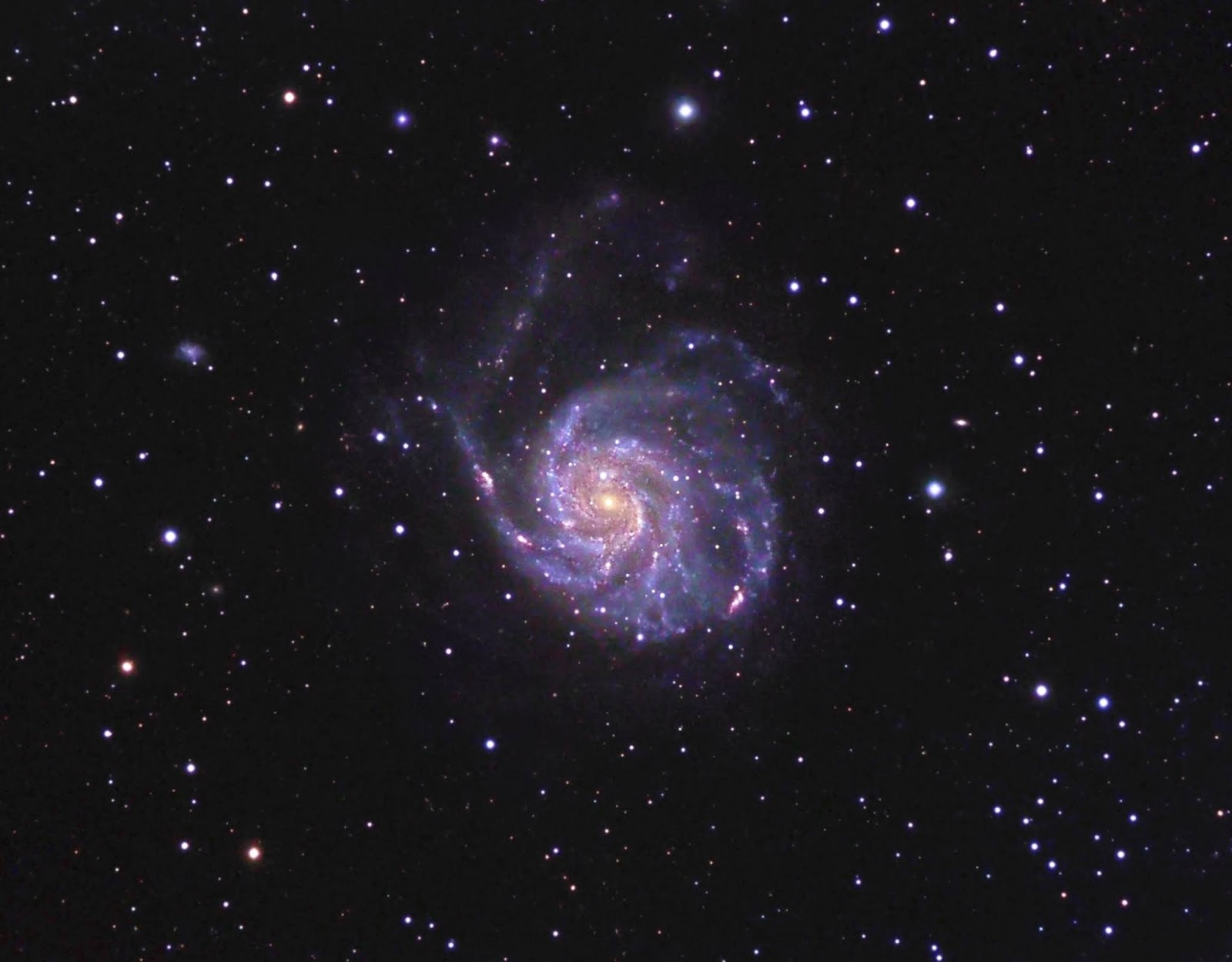
M101 - The Pinwheel Galaxy...

M101 full frame, north is up.

M101, selective stretch to show outer spiral arms (north is to the right)

Object: M101 (NGC 5457)
Type: Spiral Galaxy (morphological classification SAB (rs) cd)
Constellation: Ursa Major
Distance: 20.9 million light years
Date: March 22nd, 23rd, 2020
Equipment: ATIK 460EX with EFW2, Skywatcher f5.5 Esprit 100 ED refractor, Avalon Linear mount, guiding with Lodestar X2/PHD
Subframes: 30 x 600s luminance, 10 x 300s (2x2 binned) each for RGB, flats, bias as darks (hot pixel removal in Astroart). Above is a 70% crop of the original image.

I have had a couple of previous attempts (see here and here) at imaging this well-known and oft-imaged galaxy, always with mediocre results.  My Bortle 5 suburban sky makes LRGB imaging of this low surface brightness object a challenge, peering through a murk of light pollution that narrowband filters otherwise suppress. Spring weather in the Medway Valley is also a challenge, with skies often blurred by high cloud or a faint mist over the river.  

Nevertheless, I decided that I would try once again to do this famous galaxy justice given a rare couple of reasonably clear and moonless nights. The air was fairly unsteady and the autoguiding varied anywhere between 0.7 and 1.2 RMS, but fortunately this did not give rise to any weird star shapes (although it probably cost me some detail).

The Aurora Medwayalis always seems to put a nasty gradient of light pollution across any subframes I take towards my north-eastern outlook, even when quite high in the sky.  Fortunately the gradient removal plug-in for Astroart does a good job of flattening that out, although it is difficult to get a consistent background in each of the RGB component stacks. This gives rise to some blotchy colour noise in the dark sky background that has to be crudely hammered out with noise removal and careful background colour adjustments in PaintShop Pro. In the end, I cheated a bit by using the "magic wand" in PSP to carefully select the background without leaving behind stars, applying a "flood fill" at around 20% transparency of 20/20/20RGB, then using curves to make sure the final background comes in at around 20/20/20. This seems to get rid of the worst of the coloured blobs lurking in the dark bits without totally wiping out faint background stars.  It does make the background a bit black for IPad screens, but cranking up the brightness then starts to show colour noise again, so I've left it as is. It looks fine on my (carefully calibrated!) PC screen.

The image above is my best effort to date though, and I am satisfied enough to leave this one alone now. Actually, I'm not really. I think the raw data is probably workable, but maybe I need to look at better processing.

There are also several faint background galaxies in the full camera field of view. I have tried to identify some of these on the luminance frame below:


Annotated luminance frame of M101 showing other objects in field

A star atlas also shows the disc of M101 to be strewn with numerous NGC objects. These are bright star fields in the galaxy itself, some initially observed in 1851 by Bindon Stoney using the Birr Castle reflector, with others being noted a few years later by William Herschel, long after the recognition of M101 as a celestial object by Pierre Mechain in 1781.  Mechain had observed the 7" core of what was eventually found to be an object some 28" across (the full moon is about 30" in diameter). It took the advent of larger telescopes and astrophotography to realise that the various observations were of parts of the same extremely faint object.

Further information about this galaxy can be found in an earlier post here.