Showing posts with label lunar eclipse. Show all posts

Wednesday, 17 July 2019

Partial Lunar Eclipse...

Partial lunar eclipse, approx. 22.15 BST
Object: Moon
Constellation: Sagittarius
Distance: 398865 km (247843 miles)
Date: June 16th, 2019
Equipment: Canon 450D, Celestron NexStar 4
Subframes: Approx 30, ranging from 0.1s to 2s @ ISO800

The Moon was only 7 degrees above the horizon when I took images for the above composite.  The partial eclipse began with the moon entering the Earth's shadow at 9 pm, just as it was appearing above the horizon. Maximum eclipse was at 20.30, with the Moon leaving the Earth's umbral shadow at midnight.

The low altitude meant the focussing was tricky and a lot of lunar detail was blurred by the unsteady atmosphere so close to the horizon, along with some wispy clouds. I took a range of exposures to try and capture details on the illuminated portion of the moon and also to try and show the eclipsed area, whose glow was quite distinct in binoculars. 

I used Registax and PaintShop Pro to pull together the best shots from around 30 images taken with various exposures. With a lot of messing around, I managed to combine the image sets into something that resembled the view through binoculars.

Monday, 21 January 2019

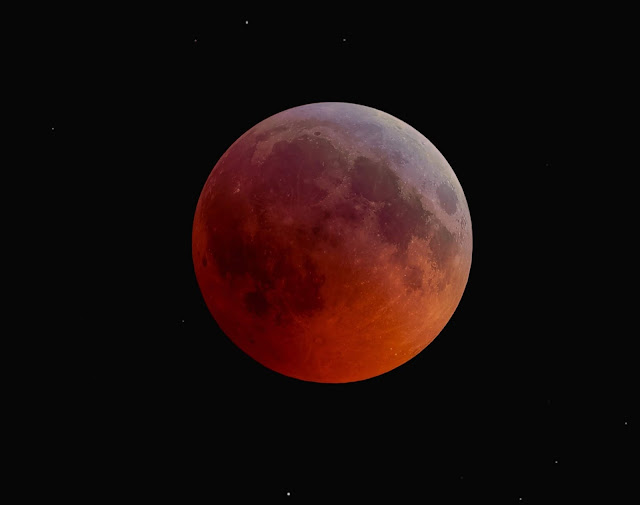
Lunar eclipse...

Total lunar eclipse @ 05.00h, 21-01-2019
Object: Moon
Constellation: Cancer
Distance: 357730 km (222282 miles)
Date: January 21st. 2019
Equipment: Canon 450D, Vixen 114mm f5.3 ED114 refractor, NEQ6 mount
Subframes: 20 x 1/2s @ ISO800, stacked and sharpened in Registax 2.1.14

The excitable UK press had billed this celestial event as a “Super-Blood-Wolf-Moon” or some such gibberish. 

During this lunar eclipse, the moon was close to perigee, the closest point to Earth in its orbit, making the moon appear slightly larger than usual. This phenomenon has been dubbed a “supermoon” by the popular press, and is not an official astronomical term.  Of the possible 12 or 13 full (or new) moons each year, usually three or four may be classified as supermoons, so they are not particularly rare. Even then, a full moon at perigee appears only about 14% larger in diameter than at apogee, a difference that is barely discernible to the visual observer.

The popular press now also seems to call lunar eclipses “blood moons” because of the way the Moon can turn a deep coppery red colour during its eclipse. The effect is caused by atmospheric dust scattering higher frequency blue light waves, but allowing the longer wavelength of red light to come comes through.  A similar effect is in evidence just as the moon rises above the horizon, where the moon’s light has to travel through a deeper layer of dust-laden air. 

Until recently I hadn’t heard of the term “blood moon”, but I guess the popular media like it because it sounds dramatic. They also threw the term “wolf moon” in there, enabling them to depict Earth’s natural satellite as undergoing some B-movie werewolf transition.

Native American Indians have traditional names for all of the full moons throughout the year: January’s full moon is called the “Wolf Moon”. If the eclipse had occurred in March, the press would have been disappointed: “NotSoSuperBloodWormMoon” doesn’t sound quite as dramatic.

The colour of the Moon during totality depends on the global state of dust in the Earth’s atmosphere; sometimes it is so dark a red as to render the moon virtually invisible.

This particular eclipse was not as dark as the one of September 2015 and was clearly visible despite the misty, damp and freezing (-4°C) conditions of the Medway valley adding to a high cloud haze.  This seems to have added its own palette to the few images I was able to get between clouds, which cleared just enough at 5 a.m. to show an unusual blue tint to the brighter edge of the fully eclipsed moon.

The next total lunar eclipse that will be completely visible in the UK is not until 20th/21st of December 2029.  Approximate timings for the south-east of England are as below:

Moon enters penumbra:             19:40
Moon enters umbra:                  20:55
Start of totality:                        22:15
Maximum eclipse:                     22:40
End of totality:                          23:10
Moon leaves umbra:                  00:30
Moon leaves penumbra:             01:40

The eclipse will be well-placed for observing (conditions permitting!), being high up on the Orion/Gemini/Taurus border. 

Monday, 28 September 2015

Lunar eclipse...

A series of shots taken back in 2015, my first astrophotos in over 5 years, what with house moves, work and life in general, etc etc...

01.10 BST

Date: 28 September 2015
Equipment: Canon 450D, Vixen ED 114mm aperture f5.3 refractor
Subframes: 16 x 1/4000s @ ISO400, stacked and sharpened in Registax 2.1.14

02.35 BST

Date: 28 September 2015
Equipment: Canon 450D, Vixen ED 114mm aperture f5.3 refractor
Subframes: 16 x 1/1600s @ ISO400, stacked and sharpened in Registax 2.1.14

03.05 BST

Date: 28 September 2015
Equipment: Canon 450D, Vixen ED 114mm aperture f5.3 refractor
Subframes: 16 x 1/5s @ ISO800, stacked and sharpened in Registax 2.1.14

03.50 BST: maximum eclipse

Date: 28 September 2015
Equipment: Canon 450D, Vixen ED 114mm aperture f5.3 refractor
Subframes: 20 x 1/2s @ ISO800, stacked and sharpened in Registax 2.1.14

04.30 BST

Date: 28 September 2015
Equipment: Canon 450D, Vixen ED 114mm aperture f5.3 refractor
Subframes: 16 x 1/5s @ ISO800, stacked and sharpened in Registax 2.1.14.

This single 5 second exposure at ISO800 at 03.50 captures the surrounding stars in Pisces down to 11.5 magnitude:


I couldn't capture the exit of the moon from the Earth's umbral shadow as it went behind my house. Bad planning on my part.

The next total lunar eclipse visible from the UK will be during the early morning of 21st. January 2019. Exact times will depend upon your location, but will be approximately as follows:

Moon enters penumbra:  02:30
Moon enters umbra:       03:30
Start of totality:              04:40
Maximum eclipse:          05:10
End of totality:               05:40
Moon leaves umbra:       06:50
Moon leaves penumbra:  07:50