Showing posts with label Galaxy. Show all posts

Saturday, 20 March 2021

Messier 63...

Messier 63

Object: Messier 63 (The "Sunflower Galaxy", M63, NGC 5055, PGC 46153, UGC 8334)
Type: Spiral galaxy (classification SA(rs)bc)
Constellation: Canes Venatici
Distance: 30 million light years
Date: March 19th 2021
Equipment: Vixen VC200L with x0.71 focal reducer, SX694, Avalon Linear mount, guiding with Lodestar X2/PHD
Subframes: 60 x 60s (2x2 binned) for luminance, 20 x 60s (2x2 binned) each for red, green and blue, flats, no darks (hot pixel removal in Astroart).

Messier 63 (M63, also known as the Sunflower Galaxy) was discovered in 1779 by the French astronomer Pierre Méchain and was the first of 24 objects that Méchain would contribute to Charles Messier’s catalogue.

High overhead on late Spring evenings, M63 is tucked away under the tail of the Great Bear in the obscure constellation of Canes Venatici.  It can be seen in binoculars as a small, hazy patch of light or an out-of-focus star.  The Stellarium sky map below shows M63’s location.

As seen in the sky from Earth, the galaxy occupies an area of 12.6 by 7.2 arc minutes, which corresponds to a spatial diameter of 98,000 light years. This makes it roughly the same size as the Milky Way, having a mass around 140 billion times that of the Sun.

Messier 63 has a distinctive appearance that gives rise to the “Sunflower” nickname, with a yellowish central disc and a number of short spiral arm segments dotted with starburst regions and dust lanes.

M63 is a prototype for a class of galaxies known as “flocculent spirals". Such galaxies seem to have many spiral arms that appear patchy and discontinuous, although infrared observations indicate that M63 is in fact a two-armed spiral structure.

Messier 63 is one of the members of the M51 Group, a group of gravitationally bound galaxies located in Canes Venatici, named after the brightest member of the group, Messier 51 (the Whirlpool Galaxy).

In 2011, astronomers discovered a tidal stellar stream in the galaxy’s halo. The faint giant arc-loop feature had been detected as early as 1979, but not connected to a minor merger with a dwarf satellite galaxy, disrupted as a result of interaction with M63. The stream of stars originated from the accretion of the smaller galaxy within the last 5 billion years. The fate of the dwarf galaxy is unknown, but the colour of the stars indicates that it was probably a galaxy belonging to the Local Group.

The recent and unprecedented run of overcast weather means that this winter’s nebula season has been pretty much clouded out. I have therefore packed away the refractor and decided to try and go for some galaxies using my ancient Vixen VC200L and a x0.71 focal reducer.  I am hoping to capture some of the brighter spring galaxies, using short exposures so that I can complete imaging projects in a single night and not have to hope that I can get two or three clear nights to collect enough data.

This was a test run of the concept and it seemed to go OK.  The subs appeared slightly vignetted and there were some horrible dust doughnuts, but a combination of flat fields and Astroart’s gradient removal tool seemed to clean up the worst of it all.

The exposures were not deep enough to clearly reveal M63’s tidal halo referenced above, but it was nice to get enough data for a colour image within three hours.

References: 

1)         https://www.nasa.gov/feature/goddard/2017/messier-63-the-sunflower-galaxy

2)              https://www.cosmotography.com/images/small_ngc5055.html

3)         https://www.messier-objects.com/messier-63-sunflower-galaxy/

Friday, 24 April 2020

M106 and friends...

M106 and adjacent galaxies

Object: Messier 106 (NGC 4258)
Type: Spiral Galaxy (morphological classification SABbc)
Constellation: Canes Venatici
Distance: 24 million light years
Date: April 22nd 2020
Equipment: ATIK 460EX with EFW2, Skywatcher f5.5 Esprit 100 ED refractor, Avalon Linear mount, guiding with Lodestar X2/PHD
Subframes: 12 x 600s luminance, 12 x 300s (2x2 binned) each for RGB, flats for each channel, bias as darks (hot pixel removal in Astroart).


High overhead in on April evenings, the galactic north pole looks out beyond the arms of our own Milky Way galaxy and into the chilling depths of intergalactic space. 

Stellarium map showing location of image field
Mid-way between Beta Canum Venaticorum (a 4th magnitude star called Chara, second brightest star in the rather obscure constellation of Canes Venatici – the Hunting Dogs – which is tucked beneath the handle of the Plough) and gamma Ursae Majoris (Phecda, also called Phad, the left-hand star in the bowl of the Plough), lies the distant spiral galaxy Messier 106.

It was discovered by the French astronomer Pierre Méchain in July of 1781. Méchain mentioned the discovery in a letter to fellow astronomer Johann Bernoulli dated May 6, 1783:

The galaxy, however, was not included in the Messier Catalogue until 1947, when Canadian astronomer Helen Sawyer Hogg added it (along with galaxies M105 and M107) based on Méchain’s letter.

William Herschel independently discovered M106 on March 9, 1788

M106 - crop from above image
Located a little over 20 million light-years away, practically a neighbour by cosmic standards, Messier 106 is one of the brightest and nearest spiral galaxies to our own. NGC 4248, a small galaxy which can be seen next to M106 in the cropped image opposite and which lies at a similar distance, is thought to be a satellite of M106.

M106 occupies an area of 18.6 by 7.2 arc minutes of apparent sky, corresponding to a spatial diameter of 135,000 light years. It has a high surface brightness (an apparent magnitude of 9.1) and can be glimpsed in binoculars, which reveal a faint patch of light.
  
Messier 106 is classified as a SABbc type galaxy, which means that it is an intermediate between a normal and barred spiral galaxy. It is home to at least 400 billion stars, being similar in size and luminosity to the Andromeda Galaxy (M31) and making it one of the brightest, largest nearby galaxies.

It is also classified as a Seyfert II galaxy, having an active nucleus. It has a considerably larger extent in radio than in visible light and exhibits emission line spectra from the nucleus. M106 shows unusual emission lines and X-rays, indicating that a portion of the galaxy is falling into an active central super-massive black hole.

Luminance frame, showing galaxies in the field of M106
Several other NGC galaxies occupy the same field of view shown in the main image. The edge-on spiral NGC 4217 is thought to be approximately 60 million light years away, whilst the galaxy pair NGC 4231 and 4232 are thought to be 350 million light years away. Other un-named tiny galaxies, rendered as mere smudges of light by their unimaginable distances, can be seen scattered across the luminance frame shown opposite. Even given the vast distance of M106, it is a mere foreground object compared to the remoteness offered up by intergalactic space.

The evening of April 22nd was very clear, but the seeing was initially somewhat shaky. I therefore set out to gather blue binned data, but the seeing improved and as the guiding accuracy dropped to 0.6” RMS, I switched to collecting full frame luminance, finishing off with some red and green binned data before the sky began to brighten. The green frames were plagued by a bit of a gradient, partly because a haze had set in, and partly because the dawn light was making itself apparent

The final luminance image was a bit noisy, and probably requires more than the 2 hours of data that I collected. 

One bonus of seeing the dawn come in was the sight of Jupiter and Saturn, a mere 5 degrees apart, rising above my south-eastern horizon.

Monday, 20 April 2020

The Owl and the Surfboard...

M97 and M108
Objects: M97 (NGC 3587), M108 (NGC 3556)
Type: Planetary nebula (M97) and Spiral Galaxy (M108, morphological classification SBbc)
Constellation: Ursa Major
Distance: 2000 light years (M97), 46 million light years (M108)
Date: April 15th and 19th. 2020
Equipment: ATIK 460EX with EFW2, Skywatcher f5.5 Esprit 100 ED refractor, Avalon Linear mount, guiding with Lodestar X2/PHD
Subframes: 12 x 600s H-alpha, 12 x 600s OIII, 12 x 600s luminance, 10 x 300s (2x2 binned) each for RGB, flats for all channels, bias as darks (hot pixel removal in Astroart). 

These two objects from the Messier catalogue are pictured above in the same one-degree field of view, located overhead in late Spring evenings adjacent to the star Merak (beta Ursae Majoris) in the bowl of the "Big Dipper". Though they may seem close to each other, the bluish disc of the planetary nebula M97 is a foreground object that lies a "mere" 2000 light years away within our own Milky Way galaxy, whilst M108 is a giant galaxy in its own right, 110,000 light years in diameter and nearly 46 million light years distant.


Stellarium map showing image field
The Owl Nebula is a planetary nebula named after its distinctive appearance, resembling a pair of owl-like eyes, which can be seen in larger telescopes. 

Its apparent dimensions in the sky are 3′.4 x 3′.3, or about a tenth of the diameter of the full moon. 

It was discovered by the French astronomer Pierre Méchain, Charles Messier’s friend and colleague, on February 16, 1781. Messier included the object in his catalogue on March 24, 1781.

Upon discovery, Méchain reported that the nebula was a difficult object to see.
 
Messier noted: “Nebula in the Great Bear, near Beta: It is difficult to see, reports M. Méchain, especially when one illuminates the micrometer wires: its light is faint, without a star. M. Méchain saw it the first time on Feb 16, 1781, & the position is that given by him.  Near this nebula he has seen another one which has not yet been determined, and also a third which is near Gamma of the Great Bear.”

The two “nebulae” Messier mentioned in his description of M97 are barred spiral galaxies later named Messier 108 (in the field of view above) and Messier 109 by the American astronomer Owen Gingerich, and added to Messier’s catalogue in 1960

The estimated age of the Owl Nebula is about 8,000 years. The Owl Nebula was formed when its parent star expelled its outer gaseous layers about 8,000 years ago. As the outer layers were gradually blown off over thousands of years, what was left of the original star contracted to form a hot white dwarf. The 16th magnitude central star has 55 to 60 percent of the Sun’s mass, only 4 percent of the Sun’s radius, and an estimated surface temperature of 123,000 K. The star can be seen between the Owl’s eyes. Its radiation is responsible for the nebula’s glow (see my notes on M27 for information about planetary nebulae).

Most stars that expel material to form planetary nebulae – about 80 percent of them – expel a large amount of it in two opposing directions. The jets blown off by the progenitor star of the Owl Nebula are almost aligned with our line of sight. The dust within the jets blocks enough light from the expanding nebula to create the appearance of owl-like eyes.

One of the nebula’s eyes appears darker than the other. This is the jet that is emitted in our direction,
while the fainter eye marks the jet expelled in the opposite direction, away from us.

Line of sight galaxies adjacent to M97
The nebula will gradually disperse over the next several thousand years, while the central white dwarf will cool and fade away. In about 5 billion years, our Sun will end its life in similar fashion.. 

There are several remote galaxies lying in the same line of sight as the Owl Nebula. These distant galaxies are shown in a crop of the above wide field view (see opposite).

Admiral William H. Smyth was the first to classify the object as a planetary nebula in 1844. 

M97 has about 0.13 solar masses and stretches across 0.91 light years in radius. It is expanding at an approximate speed of 27 to 39 km/s into the surrounding space.

As noted above, M108 was discovered by Pierre Méchain in 1781 three days after he discovered M97. 

Close-up of M108 from wide-field image above
M108 (known by some as the "Surfboard Galaxy") is classified as a barred spiral galaxy with loosely wound spiral arms, but visually there is little evidence of a well-defined spiral pattern in the galaxy as the spiral is inclined towards us only 15 degrees from edge-on. It is one of the larger members of the Ursa Major galactic cluster, being approximately 100,000 year years across. 

Observations show young star clusters exposed against dark dust lanes and bright emission regions. M108 also contains "super-shells", which are shells of gas driven by bursts of star formation and resulting supernova explosions. The super-shells could also be driven by stellar jets or an in-fall of gas from outside the galaxy.

At the centre of M108 is a supermassive black hole estimated to be 24 million times as massive as the Sun. The Chandra X-ray Observatory discovered multiple X-ray sources in M108, with the brightest X-ray source suspected to be an intermediately sized black hole that is actively accreting material.

I took the LRGB data on the cold, frosty evening of the 15th. There was a bit of a haze and the stars were a bit bloated. Once I had acquired the Ha and OIII data I wanted for M97, I made an RGB frame to add the star colours (in "Lighten" mode) to an HOO image, and then used the luminance data just to brighten up and add detail to M108.  Although the image scale is small, the Ha regions in both objects can definitely be seen.

Monday, 30 March 2020

The Hockey Stick and the Whale...

NGC 4656-7 and NGC 4631

Objects: NGC 4656-7 (the Hockey Stick galaxy) and NGC 4631 (the Whale galaxy)
Type: Barred Spiral Galaxies (NGC 4656-7 morphological classification SB(s)m pec), NGC 4631 SB(s)d
Constellation: Canes Venatici
Distance: 30 million light years
Date: March 26th, 2020
Equipment: ATIK 460EX with EFW2, Skywatcher f5.5 Esprit 100 ED refractor, Avalon Linear mount, guiding with Lodestar X2/PHD
Subframes: 10 x 600s luminance, 6 x 300s (2x2 binned) each for RGB, flats, bias as darks (hot pixel removal in Astroart). Above is an 80% crop of the original image.

As the winter turns to spring, so the night sky turns from a host of local galactic nebulae to the dim and chillingly distant realm of faraway galaxies. The pair of interacting galaxies pictured above can be found in the obscure constellation of Canes Venatici, tucked away beneath the handle of the Plough (see map below).


Field of NGC 4656-7 and NGC 4631
Both galaxies are classified as "barred spirals", that is, spiral galaxies that contain a central bar. However, gravitational interactions between the pair (separated by about half a million light years) have warped and twisted the smaller galaxy (NGC 4656-7, bottom left) into its contorted shape, giving rise to its nickname.

Discovered on March 20th. 1787 by William Herschel, the Hockey Stick was classified as two separate nebulae, long before their true identities as a single remote galaxy was known.  NGC 4656, the blade of the hockey stick, is a bright starburst region, originally observed as a separate entity from the main body of the galaxy, NGC 4657.

The eagle-eyed Herschel discovered NGC 4631 on the same evening.  We see this galaxy inclined only 5 degrees from edge on.  Radial velocity data suggests that if we were able to see this object from above, it would be a late-type barred spiral with very clumpy and loosely-wound arms.  Its gravitational interactions with NGC 4656 and the small satellite galaxy lying just above it (NGC 4627) have triggered a wave of star formation within NGC 4631 giving rise to its mottled appearance, with bright starburst regions standing out from surrounding galactic dust clouds.


NGC designations for the NGC 4631 group
The NGC designations are shown opposite.

The evening of March 26th was blighted by air pollution, despite the whole country being on coronavirus shut-down (plus side: no aircraft trails!) resulting in rather poor backgrounds a and noisy subframes. I also had some problems with the Avalon mount, which seemed to be "twitching" in RA, though it didn't seem to degrade image quality too much.

I have tightened up the RA clutch and I hope that problem has gone away!

Tuesday, 24 March 2020

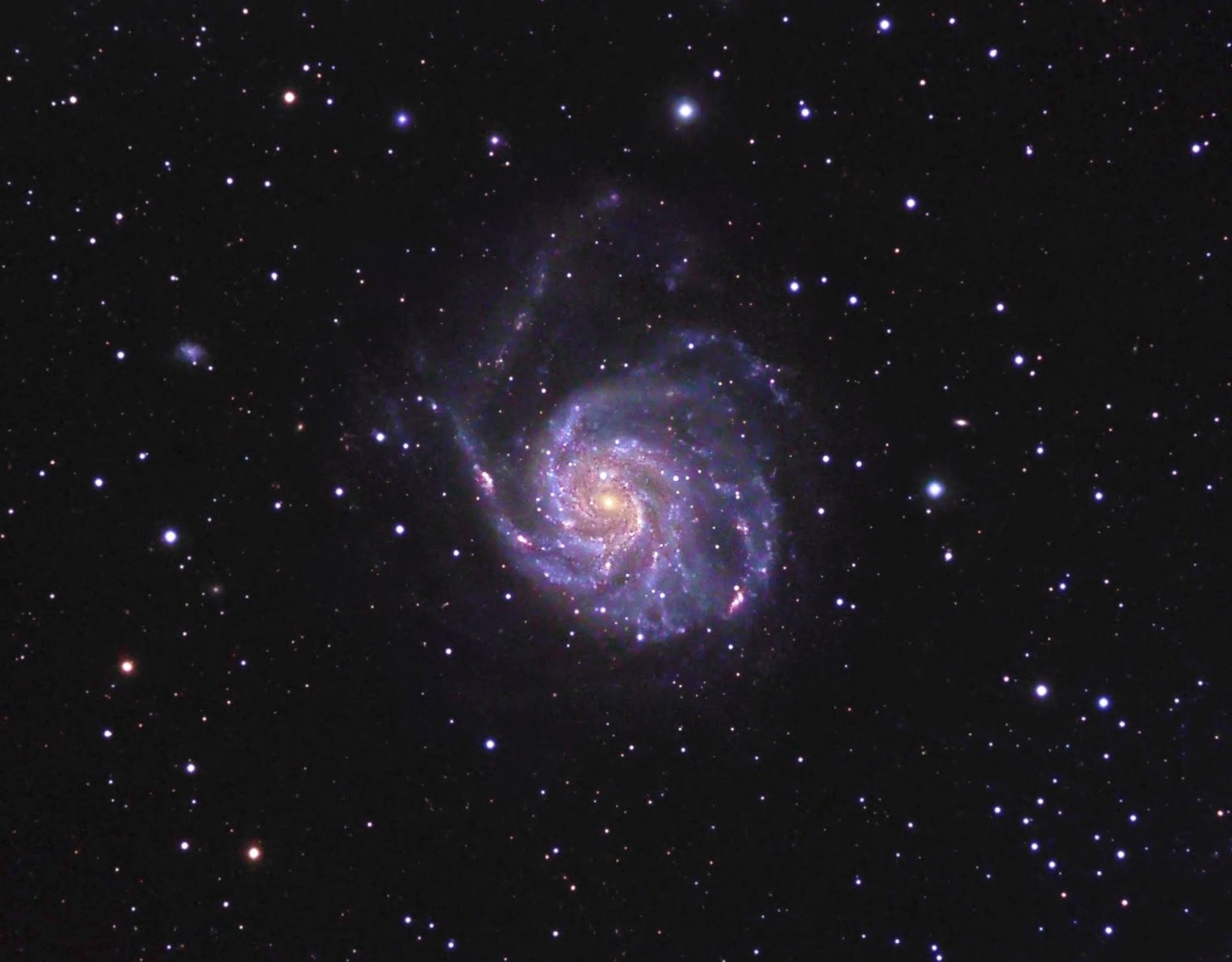
M101 - The Pinwheel Galaxy...

M101 full frame, north is up.

M101, selective stretch to show outer spiral arms (north is to the right)

Object: M101 (NGC 5457)
Type: Spiral Galaxy (morphological classification SAB (rs) cd)
Constellation: Ursa Major
Distance: 20.9 million light years
Date: March 22nd, 23rd, 2020
Equipment: ATIK 460EX with EFW2, Skywatcher f5.5 Esprit 100 ED refractor, Avalon Linear mount, guiding with Lodestar X2/PHD
Subframes: 30 x 600s luminance, 10 x 300s (2x2 binned) each for RGB, flats, bias as darks (hot pixel removal in Astroart). Above is a 70% crop of the original image.

I have had a couple of previous attempts (see here and here) at imaging this well-known and oft-imaged galaxy, always with mediocre results.  My Bortle 5 suburban sky makes LRGB imaging of this low surface brightness object a challenge, peering through a murk of light pollution that narrowband filters otherwise suppress. Spring weather in the Medway Valley is also a challenge, with skies often blurred by high cloud or a faint mist over the river.  

Nevertheless, I decided that I would try once again to do this famous galaxy justice given a rare couple of reasonably clear and moonless nights. The air was fairly unsteady and the autoguiding varied anywhere between 0.7 and 1.2 RMS, but fortunately this did not give rise to any weird star shapes (although it probably cost me some detail).

The Aurora Medwayalis always seems to put a nasty gradient of light pollution across any subframes I take towards my north-eastern outlook, even when quite high in the sky.  Fortunately the gradient removal plug-in for Astroart does a good job of flattening that out, although it is difficult to get a consistent background in each of the RGB component stacks. This gives rise to some blotchy colour noise in the dark sky background that has to be crudely hammered out with noise removal and careful background colour adjustments in PaintShop Pro. In the end, I cheated a bit by using the "magic wand" in PSP to carefully select the background without leaving behind stars, applying a "flood fill" at around 20% transparency of 20/20/20RGB, then using curves to make sure the final background comes in at around 20/20/20. This seems to get rid of the worst of the coloured blobs lurking in the dark bits without totally wiping out faint background stars.  It does make the background a bit black for IPad screens, but cranking up the brightness then starts to show colour noise again, so I've left it as is. It looks fine on my (carefully calibrated!) PC screen.

The image above is my best effort to date though, and I am satisfied enough to leave this one alone now. Actually, I'm not really. I think the raw data is probably workable, but maybe I need to look at better processing.

There are also several faint background galaxies in the full camera field of view. I have tried to identify some of these on the luminance frame below:


Annotated luminance frame of M101 showing other objects in field

A star atlas also shows the disc of M101 to be strewn with numerous NGC objects. These are bright star fields in the galaxy itself, some initially observed in 1851 by Bindon Stoney using the Birr Castle reflector, with others being noted a few years later by William Herschel, long after the recognition of M101 as a celestial object by Pierre Mechain in 1781.  Mechain had observed the 7" core of what was eventually found to be an object some 28" across (the full moon is about 30" in diameter). It took the advent of larger telescopes and astrophotography to realise that the various observations were of parts of the same extremely faint object.

Further information about this galaxy can be found in an earlier post here. 


Friday, 28 February 2020

The M81 and M82 galaxy system...

M81 and M82

Objects: Messier 81 (NGC 3031, Bode's Galaxy) and Messier 82 (NGC 3034, the Cigar Galaxy)
Type: Galaxies (classifications M81: SA(s)sb, M82: I0 ) 
Constellation: Ursa Major
Distance: 12 million light years
Dates: 20th and 27th. February 2020
Equipment: ATIK 460EX with EFW2, Skywatcher f5.5 Esprit 100 ED refractor, Avalon Linear mount, guiding with Lodestar X2/PHD
Subframes: 12 x Red, 12 x Green, 12 x Blue, 12 x  H-alpha (all 300s, 2x2 binned), 12 x 600s luminance, plus flats for each channel but no darks (hot pixel removal in Astroart).


The M81 Group is a galaxy group in the constellations Ursa Major and Camelopardalis that includes the galaxies Messier 81 and Messier 82, as well as several other galaxies with high apparent brightnesses. The approximate centre of the group is located at a distance of 12 light years, making it one of the nearest groups to the Local Group. The M81 Group, the Local Group, and other nearby groups all lie within the Virgo Supercluster (i.e. the Local Supercluster). 

Location of M81/82 field
The location of the M81/M82 group in the night sky is indicated in the Stellarium sky map opposite.

Discovered by the German astronomer Johann Elert Bode in 1774, M81 and M82 are two of the brightest galaxies in the night sky. Through a pair of binoculars, the galaxies appear as faint patches of light in the same field of view.

M81’s galaxy’s outer spiral arms are made up of young, bluish, hot stars formed in the past few million years. They also host a population of stars formed in an episode of star formation that started about 600 million years ago. Ultraviolet light from hot, young stars is the surrounding clouds of hydrogen gas to fluoresce, giving rise to the characteristic red emission nebulae that show in the above image as tiny red speckles visible strewn along the spiral arms of the galaxy. A number of dust lanes can also be seen tracing the arms into the nucleus of M81.

The galaxy’s central bulge contains much older, redder stars. It is significantly larger than the Milky Way’s bulge. A black hole of 70 million solar masses resides at the centre of M81 and is about 15 times the mass of the Milky Way’s central black hole.

M82 (nicknamed the “Cigar galaxy”) shines brightly at infrared wavelengths and is remarkable for its star formation activity. The galaxy experiences gravitational interactions with its galactic neighbour, M81, which creates an extraordinarily high rate of star formation: for this reason M82 is known as a “starburst” galaxy.

It is about five times more luminous than our Milky Way galaxy and has a centre one hundred times more luminous. As the closest starburst galaxy to Earth, M82 is the prototypical example of this galaxy type.

Around the M81’s centre, young stars are being born at a rate 10 times faster than they are inside our entire Milky Way galaxy. Radiation and energetic particles from these newborn stars carve into the surrounding gas, and the resulting galactic wind compresses enough gas to make millions of more stars. The rapid rate of star formation in this galaxy eventually will be self-limiting. When star formation becomes too vigorous, it will consume or destroy the material needed to make more stars. The starburst will then subside, probably in a few tens of millions of years.

Background galaxies in the M81/M82 field
Other distant background galaxies can be seen in this image, all of which are hundreds of millions of light years away, with the exception of Holmberg XI, which is a small satellite galaxy of M81.  Some of these chillingly distant objects are indicated in the luminance image opposite.

The region of M81 and M82 is permeated by faint trails of dust that are part of our galaxy rather than associated with the M81 group.  These Integrated Flux Nebulae are high galactic latitude nebulae that are illuminated not by a single star (as most nebulae in the plane of the Galaxy are) but by the energy from the combined light (“integrated flux”) of all the stars in our Milky Way. These IFN are very faint and were only discovered in 2005 by amateur astronomer Steve Mandel.

Stretched luminance frame showing IFN
The IFN shows only very faintly on the 600 second luminance frames taken for this image: indeed, I first thought the traces on my stacked luminance frames were actually just poorly corrected gradients or other artefacts. To get the IFN to show up, I used the stretch, followed by the equalise function in PSP, which displays every available detail in the image (see left).  This revealed traces of the IFN, albeit rather crudely.  I then applied a large Gaussian blur (4 pixels) to smooth up the noise, and then layered the smoothed frame over the LRGB in luminance mode at about 10%. The burnt-out galaxy areas were erased to give the final image, which shows the M81/M82 pair shining through the faint dusty debris of our own galaxy. The faint arcs of dust evidenced around M82 in my image appear to correspond to similar features shown in much deeper exposures.

Flats were essential in order to eliminate image artefacts from the LRGBHa stacks, which would mask the faint IFN traces.  The Ha and red frames were combined as a 30/70 blend, although it seems the H-alpha exposures were not really deep enough to fully show up the starburst tendrils of H-alpha emissions that are being ejected from the poles of M82.


Saturday, 30 March 2019

M101 - The Pinwheel Galaxy...


Object: M101 (NGC 5457)
Type: Spiral Galaxy (morphological classification SAB (rs) cd)
Constellation: Ursa Major
Distance: 20.9 million light years
Date: March 29th, 2019
Equipment: ATIK 460EX, Vixen 114mm f5.3 ED114 refractor, NEQ6 mount, guiding with Lodestar X2/PHD
Subframes: 16 x 300s each for RGB, flats but no darks (hot pixel removal in Astroart). Above is a 50% crop of the original image.

Messier 101 (M101), also known as the Pinwheel Galaxy, is a spiral galaxy located in the constellation Ursa Major. It has the designation NGC 5457 in the New General Catalogue. Discovered by Pierre Méchain on March 27, 1781, it was communicated to Charles Messier who verified its position for inclusion in the Messier Catalogue as one of its final entries.

M101 lies at a distance of 20.9 million light years from Earth. The galaxy appears face-on and occupies an area of 28.8 by 26.9 arc minutes of apparent sky (about the same size as a full moon), which corresponds to a linear diameter of about 170,000 light years, similar to our Milky Way galaxy. 

Its location in the sky is easy to find, forming an equilateral triangle with Mizar and Alkaid, two of the bright stars in the “handle” of the Plough (see the Stellarium map opposite). Despite this, the galaxy has a low surface brightness that renders it difficult to see from suburban locations.

M101 has around a trillion stars, more than twice the number of stars in the Milky Way. The galaxy has an unusually high number of H II regions, where new stars form, and many of these regions are bright and large, ionized by many extremely luminous and hot young stars.  Some of the larger and brighter ones can be seen in the above image.

Sky conditions were not good on the night of the 29th.  Although cloud and moon-free, unusually calm conditions had allowed a build-up of a rather unpleasant pollution haze in the Medway Valley, with particulates exceeding recommended annual means as evidenced on the local UKAIR monitoring site (by a factor of four on  the 30th – which mercifully dispersed with the advent of northerly winds next day).  This gave a sickly orange colour to the sky, making it very difficult to pull out luminance data from the background sky glow, to the point where I gave up and stuck with the RGB filtered sub-frames, which were not so badly contrast-compromised.

If I get the opportunity, I will try and improve the brightness and resolution of this image by the acquisition of some longer (and hopefully cleaner) luminance exposures.

Wednesday, 9 May 2018

Messier 51 - The Whirlpool Galaxy...

M51- The Whirlpool Galaxy
Object: M51 (NGC 5194/5)
Type: Spiral Galaxy
Constellation: Canes Venatici
Distance: 23,000,000 light years
Date: 6th & 7th May 2018
Equipment: SXV-H9, Vixen 114mm f5.3 ED114 refractor, NEQ6 mount, guiding with Lodestar X2/PHD
Subframes: 50 x 200s luminance, 10 x 100s each for H-alpha, G&B (2 x 2 binned), 20 flats for each channel.

Lurking high in the early summer sky just under the tip of the tail of the Great Bear, the twin cores of Messier 51 show up as two softly glowing points of light in my 8-inch VC200L.  It takes the miracle of a CCD to allow backyard astronomers to visualise the spiral structure and wispy star trails associated with this pair of interacting galaxies.  Or a large-aperture telescope...

I used H-alpha as the red channel to highlight the star-forming regions along the galaxy's spiral lanes. I have to manually refocus upon changing filters (particularly when switching from H-alpha to the RGBs) and the beefy but rather crude rack and pinion focuser on the Vixen ED114 does give rise to a fair bit of image shift. On this occasion for some reason, Astroart's co-register function subsequently struggled to line the H-alpha channel up accurately with the luminance/green/blue ones, hence some funny haloes around the stars.

But after four consecutive clear nights, sleep deprivation is starting to set in and so this one will do for now...

More about this object here...

Wednesday, 25 April 2018

M104 - The Sombrero Galaxy...


Object: M104 (NGC 4594)
Type: Elliptical galaxy
Constellation: Virgo
Distance: 31,000,000 light years
Date: 18th & 19th April 2018
Equipment: SXV-H9, Vixen 114mm f5.3 ED refractor, NEQ6 mount, guiding with Lodestar X2/PHD
Subframes: 70 x 200s luminance, 5 x 200s each for RGB 2 x 2 binned), 20 darks and bias frames, 20 flats for each channel (image stacking, hot pixel and gradient removal in Astroart, curves and colour composition in Paint Shop Pro).

I had never attempted to image this galaxy before, and thought it might be a bit of a challenge given its low location in the southern sky, which for me is also blighted by light pollution from the Aurora Maidstonealis.  M104 is quite a small object (in visual terms, of course!) for a relatively small aperture but I was curious to see how it would turn out.

In terms of imaging, I find that light pollution filters don't really offer any contrast boosting effect, and that image processing seems to be a better option to offset light sky backgrounds.

Given that these were the first clear nights in nearly six weeks I couldn't really ignore the opportunity even though the seeing wasn't great and the sky not truly dark (high haze, I think). On the plus side, the moon was new and caused no glare problems.  Nevertheless, the conditions led to somewhat noisy sub-frames with gradients that I scrubbed up as best I could using the nifty Astroart gradient removal plug-in, plus noise flattening in PaintShop Pro (curves and edge preserving smooth).  I don't normally bother with dark frames but it did seem to help with the background noise in this case.  My ancient SXV-H9 camera is not set-point cooling regulated and so maybe the warmer weather is adding a dose of electronic noise to my subs.

The output is never going to win any prizes of course, but in the end I was sort of OK with this effort, even if it only shows the dust lane and little else.

Good old Wikipedia tells us more about this object here...

Saturday, 9 December 2017

M33 - The Triangulum Galaxy

Click on image to enlarge

Object: Messier 33 (NGC 598/604)
Type: Spiral galaxy 
Distance: 3,000,000 light years 
Constellation: Triangulum
Date: 25 November & 07 December 2017
Equipment: SXV-H9, Vixen 114mm f5.3 ED refractor, guiding with Lodestar X2/PHD
Subframes: 50 x 300s luminance (via an Astronomix CLS filter), 20 x 80s 2x2 binned each for Ha, RGB

Images acquired, pre-processed and stacked in Astroart.  Digital development and high/low pass filters applied, colour composited all in Astroart.  Final cosmetic processing (cropping, mild edge preserving smooth for noise) in PaintShop Pro.

The bright red patch at upper right centre is NGC 604, the brightest of the numerous H-alpha emission regions in this galaxy.  This image could have probably done with longer luminance subs as the outer arms are not as well defined as I would have liked.  I had previously imaged M33 in "white light" and actually got better luminance data with shorter exposures, suggesting that the CLS filter wasn't actually helping

More information about this object can be found here.

A 40mm eyepiece on the ED114 shows M33 up as a definite central glow fading to a less obvious oval, featureless glow about half the size of the full moon. This seems to equate to the brighter inner arms as shown in the image above. Visually, I can't see any hint of spiral structure.