Monday, 30 March 2020

The Hockey Stick and the Whale...

NGC 4656-7 and NGC 4631

Objects: NGC 4656-7 (the Hockey Stick galaxy) and NGC 4631 (the Whale galaxy)
Type: Barred Spiral Galaxies (NGC 4656-7 morphological classification SB(s)m pec), NGC 4631 SB(s)d
Constellation: Canes Venatici
Distance: 30 million light years
Date: March 26th, 2020
Equipment: ATIK 460EX with EFW2, Skywatcher f5.5 Esprit 100 ED refractor, Avalon Linear mount, guiding with Lodestar X2/PHD
Subframes: 10 x 600s luminance, 6 x 300s (2x2 binned) each for RGB, flats, bias as darks (hot pixel removal in Astroart). Above is an 80% crop of the original image.

As the winter turns to spring, so the night sky turns from a host of local galactic nebulae to the dim and chillingly distant realm of faraway galaxies. The pair of interacting galaxies pictured above can be found in the obscure constellation of Canes Venatici, tucked away beneath the handle of the Plough (see map below).


Field of NGC 4656-7 and NGC 4631
Both galaxies are classified as "barred spirals", that is, spiral galaxies that contain a central bar. However, gravitational interactions between the pair (separated by about half a million light years) have warped and twisted the smaller galaxy (NGC 4656-7, bottom left) into its contorted shape, giving rise to its nickname.

Discovered on March 20th. 1787 by William Herschel, the Hockey Stick was classified as two separate nebulae, long before their true identities as a single remote galaxy was known.  NGC 4656, the blade of the hockey stick, is a bright starburst region, originally observed as a separate entity from the main body of the galaxy, NGC 4657.

The eagle-eyed Herschel discovered NGC 4631 on the same evening.  We see this galaxy inclined only 5 degrees from edge on.  Radial velocity data suggests that if we were able to see this object from above, it would be a late-type barred spiral with very clumpy and loosely-wound arms.  Its gravitational interactions with NGC 4656 and the small satellite galaxy lying just above it (NGC 4627) have triggered a wave of star formation within NGC 4631 giving rise to its mottled appearance, with bright starburst regions standing out from surrounding galactic dust clouds.


NGC designations for the NGC 4631 group
The NGC designations are shown opposite.

The evening of March 26th was blighted by air pollution, despite the whole country being on coronavirus shut-down (plus side: no aircraft trails!) resulting in rather poor backgrounds a and noisy subframes. I also had some problems with the Avalon mount, which seemed to be "twitching" in RA, though it didn't seem to degrade image quality too much.

I have tightened up the RA clutch and I hope that problem has gone away!

Tuesday, 24 March 2020

M101 - The Pinwheel Galaxy...

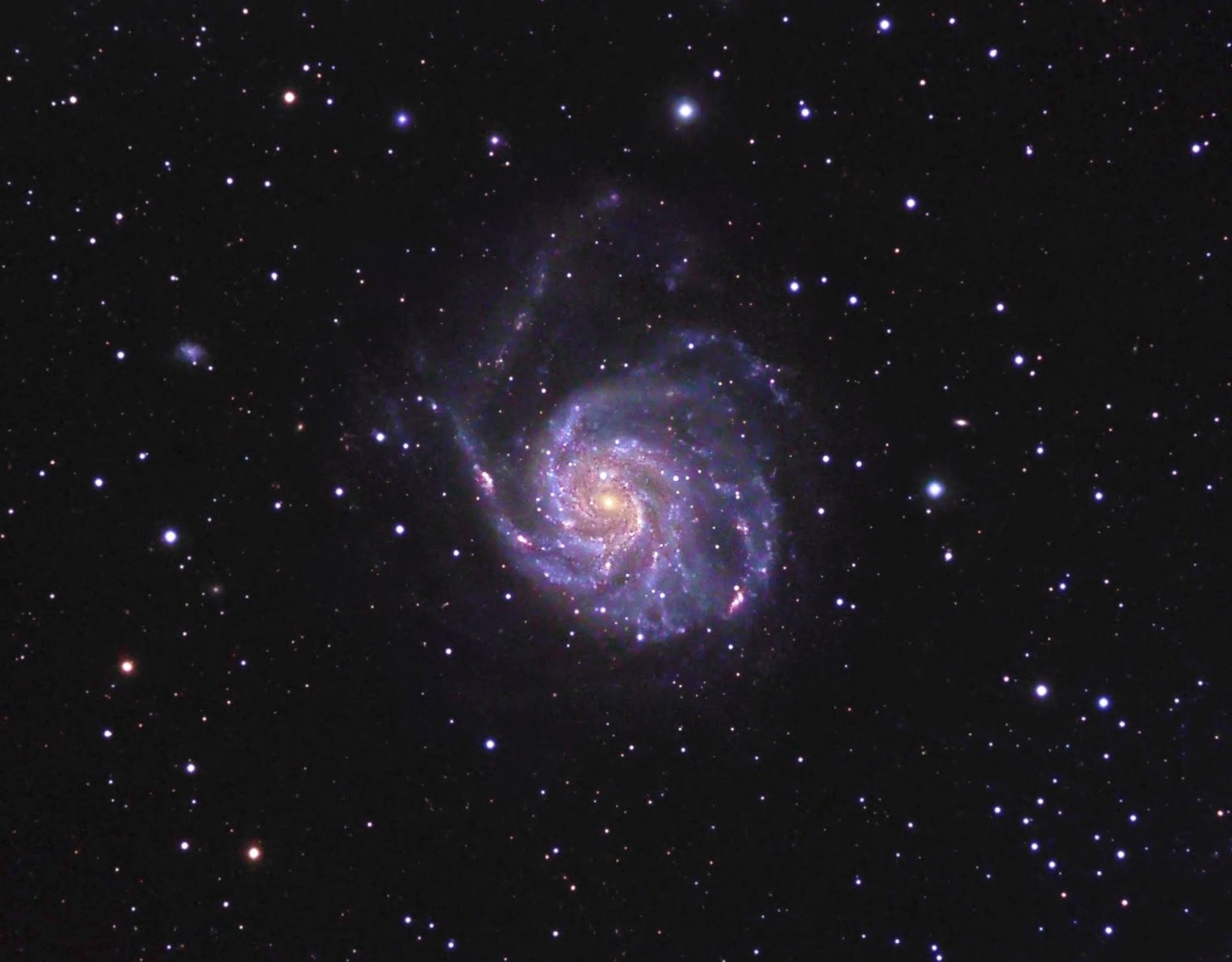
M101 full frame, north is up.

M101, selective stretch to show outer spiral arms (north is to the right)

Object: M101 (NGC 5457)
Type: Spiral Galaxy (morphological classification SAB (rs) cd)
Constellation: Ursa Major
Distance: 20.9 million light years
Date: March 22nd, 23rd, 2020
Equipment: ATIK 460EX with EFW2, Skywatcher f5.5 Esprit 100 ED refractor, Avalon Linear mount, guiding with Lodestar X2/PHD
Subframes: 30 x 600s luminance, 10 x 300s (2x2 binned) each for RGB, flats, bias as darks (hot pixel removal in Astroart). Above is a 70% crop of the original image.

I have had a couple of previous attempts (see here and here) at imaging this well-known and oft-imaged galaxy, always with mediocre results.  My Bortle 5 suburban sky makes LRGB imaging of this low surface brightness object a challenge, peering through a murk of light pollution that narrowband filters otherwise suppress. Spring weather in the Medway Valley is also a challenge, with skies often blurred by high cloud or a faint mist over the river.  

Nevertheless, I decided that I would try once again to do this famous galaxy justice given a rare couple of reasonably clear and moonless nights. The air was fairly unsteady and the autoguiding varied anywhere between 0.7 and 1.2 RMS, but fortunately this did not give rise to any weird star shapes (although it probably cost me some detail).

The Aurora Medwayalis always seems to put a nasty gradient of light pollution across any subframes I take towards my north-eastern outlook, even when quite high in the sky.  Fortunately the gradient removal plug-in for Astroart does a good job of flattening that out, although it is difficult to get a consistent background in each of the RGB component stacks. This gives rise to some blotchy colour noise in the dark sky background that has to be crudely hammered out with noise removal and careful background colour adjustments in PaintShop Pro. In the end, I cheated a bit by using the "magic wand" in PSP to carefully select the background without leaving behind stars, applying a "flood fill" at around 20% transparency of 20/20/20RGB, then using curves to make sure the final background comes in at around 20/20/20. This seems to get rid of the worst of the coloured blobs lurking in the dark bits without totally wiping out faint background stars.  It does make the background a bit black for IPad screens, but cranking up the brightness then starts to show colour noise again, so I've left it as is. It looks fine on my (carefully calibrated!) PC screen.

The image above is my best effort to date though, and I am satisfied enough to leave this one alone now. Actually, I'm not really. I think the raw data is probably workable, but maybe I need to look at better processing.

There are also several faint background galaxies in the full camera field of view. I have tried to identify some of these on the luminance frame below:


Annotated luminance frame of M101 showing other objects in field

A star atlas also shows the disc of M101 to be strewn with numerous NGC objects. These are bright star fields in the galaxy itself, some initially observed in 1851 by Bindon Stoney using the Birr Castle reflector, with others being noted a few years later by William Herschel, long after the recognition of M101 as a celestial object by Pierre Mechain in 1781.  Mechain had observed the 7" core of what was eventually found to be an object some 28" across (the full moon is about 30" in diameter). It took the advent of larger telescopes and astrophotography to realise that the various observations were of parts of the same extremely faint object.

Further information about this galaxy can be found in an earlier post here. 


Monday, 16 March 2020

The Spider and the Fly...

NGC 1931 and IC 417

Objects: NGC 1931 (star cluster with emission/reflection nebula Sharpless 2-237, IC 417 (Sh2-234, Spider nebula, with star cluster Stock 8)
Type: Emission Nebulae 
Constellation: Auriga
Distance: 7500 light years
Dates: 12th. March 2020
Equipment: ATIK 460EX with EFW2, Skywatcher f5.5 Esprit 100 ED refractor, Avalon Linear mount, guiding with Lodestar X2/PHD
Subframes: 3 x Red (300s, 2x2 binned), 3 x Green (300s, 2x2 binned), 6 x Blue (450s, 2x2 binned), 9 x 600s H-alpha, flats for each channel, no darks (hot pixel removal in Astroart).


Stellarium map showing field of IC 417
Between Theta Aurigae and Iota Aurigae (the two southernmost stars of the “kite” of the constellation of Auriga) lies a string of emission nebulae. The above image shows another two faint areas of nebulosity lying between the brighter and better known nebulae IC 410 and IC 405 and the "Pumpkin Patch".

Two large OB associations have traditionally been identified in the constellation of Auriga, aligned one behind the other. The first is indicated with the abbreviation Auriga OB1.  Twelve stars of the spectral classes O and B were initially designated as effective members of the association, to which are added three red supergiants at the end of their life cycle. The suggested distance was about 1750 parsecs and was therefore placed on the galactic Arm of Perseus.  The second association is indicated as Auriga OB2 and eight class O and B stars were associated to it, mostly on the main sequence; its distance was indicated at least 6300 parsecs, i.e. in a remote area of the outer disk of the Milky Way, on the Cygnus Arm.


The estimated distance of IC 417 suggests it to be close to the Auriga OB1 association.

The image itself is fairy noisy, as clouds cut short the imaging session and I was only able to grab nine Ha frames to use as luminance: not that I would have been able to get to many more anyway, as the object was sinking into the western horizon.

Sunday, 8 March 2020

Moon...

Moon, 88% of full phase
Object: Moon
Constellation: Cancer
Distance: 367980 km (228652 miles)
Dates: 6th. March 2020
Equipment: ATIK 460EX with EFW2, Skywatcher f5.5 Esprit 100 ED refractor, Avalon Linear mount, guiding with Lodestar X2/PHD
Subframes: 100 x  H-alpha (0.001s), 100 x OIII (0.001s)

The H-alpha and OIII frames were stacked in Registax and wavelet sharpened. The histograms of each were carefully stretched to match each other, and then combined as HOO for RGB.  Unsurprisingly, the image is not particularly colourful: some images of the moon you see have lurid blues, greens and reds but such colours are largely artefacts.

I used the Ha and OIII filters largely as light rejection filters, as the moon is otherwise so bright it would overwhelm the sensitive CCD camera.  There was little visual difference in appearance between the Ha and OIII stacks.

Friday, 28 February 2020

The M81 and M82 galaxy system...

M81 and M82

Objects: Messier 81 (NGC 3031, Bode's Galaxy) and Messier 82 (NGC 3034, the Cigar Galaxy)
Type: Galaxies (classifications M81: SA(s)sb, M82: I0 ) 
Constellation: Ursa Major
Distance: 12 million light years
Dates: 20th and 27th. February 2020
Equipment: ATIK 460EX with EFW2, Skywatcher f5.5 Esprit 100 ED refractor, Avalon Linear mount, guiding with Lodestar X2/PHD
Subframes: 12 x Red, 12 x Green, 12 x Blue, 12 x  H-alpha (all 300s, 2x2 binned), 12 x 600s luminance, plus flats for each channel but no darks (hot pixel removal in Astroart).


The M81 Group is a galaxy group in the constellations Ursa Major and Camelopardalis that includes the galaxies Messier 81 and Messier 82, as well as several other galaxies with high apparent brightnesses. The approximate centre of the group is located at a distance of 12 light years, making it one of the nearest groups to the Local Group. The M81 Group, the Local Group, and other nearby groups all lie within the Virgo Supercluster (i.e. the Local Supercluster). 

Location of M81/82 field
The location of the M81/M82 group in the night sky is indicated in the Stellarium sky map opposite.

Discovered by the German astronomer Johann Elert Bode in 1774, M81 and M82 are two of the brightest galaxies in the night sky. Through a pair of binoculars, the galaxies appear as faint patches of light in the same field of view.

M81’s galaxy’s outer spiral arms are made up of young, bluish, hot stars formed in the past few million years. They also host a population of stars formed in an episode of star formation that started about 600 million years ago. Ultraviolet light from hot, young stars is the surrounding clouds of hydrogen gas to fluoresce, giving rise to the characteristic red emission nebulae that show in the above image as tiny red speckles visible strewn along the spiral arms of the galaxy. A number of dust lanes can also be seen tracing the arms into the nucleus of M81.

The galaxy’s central bulge contains much older, redder stars. It is significantly larger than the Milky Way’s bulge. A black hole of 70 million solar masses resides at the centre of M81 and is about 15 times the mass of the Milky Way’s central black hole.

M82 (nicknamed the “Cigar galaxy”) shines brightly at infrared wavelengths and is remarkable for its star formation activity. The galaxy experiences gravitational interactions with its galactic neighbour, M81, which creates an extraordinarily high rate of star formation: for this reason M82 is known as a “starburst” galaxy.

It is about five times more luminous than our Milky Way galaxy and has a centre one hundred times more luminous. As the closest starburst galaxy to Earth, M82 is the prototypical example of this galaxy type.

Around the M81’s centre, young stars are being born at a rate 10 times faster than they are inside our entire Milky Way galaxy. Radiation and energetic particles from these newborn stars carve into the surrounding gas, and the resulting galactic wind compresses enough gas to make millions of more stars. The rapid rate of star formation in this galaxy eventually will be self-limiting. When star formation becomes too vigorous, it will consume or destroy the material needed to make more stars. The starburst will then subside, probably in a few tens of millions of years.

Background galaxies in the M81/M82 field
Other distant background galaxies can be seen in this image, all of which are hundreds of millions of light years away, with the exception of Holmberg XI, which is a small satellite galaxy of M81.  Some of these chillingly distant objects are indicated in the luminance image opposite.

The region of M81 and M82 is permeated by faint trails of dust that are part of our galaxy rather than associated with the M81 group.  These Integrated Flux Nebulae are high galactic latitude nebulae that are illuminated not by a single star (as most nebulae in the plane of the Galaxy are) but by the energy from the combined light (“integrated flux”) of all the stars in our Milky Way. These IFN are very faint and were only discovered in 2005 by amateur astronomer Steve Mandel.

Stretched luminance frame showing IFN
The IFN shows only very faintly on the 600 second luminance frames taken for this image: indeed, I first thought the traces on my stacked luminance frames were actually just poorly corrected gradients or other artefacts. To get the IFN to show up, I used the stretch, followed by the equalise function in PSP, which displays every available detail in the image (see left).  This revealed traces of the IFN, albeit rather crudely.  I then applied a large Gaussian blur (4 pixels) to smooth up the noise, and then layered the smoothed frame over the LRGB in luminance mode at about 10%. The burnt-out galaxy areas were erased to give the final image, which shows the M81/M82 pair shining through the faint dusty debris of our own galaxy. The faint arcs of dust evidenced around M82 in my image appear to correspond to similar features shown in much deeper exposures.

Flats were essential in order to eliminate image artefacts from the LRGBHa stacks, which would mask the faint IFN traces.  The Ha and red frames were combined as a 30/70 blend, although it seems the H-alpha exposures were not really deep enough to fully show up the starburst tendrils of H-alpha emissions that are being ejected from the poles of M82.


Monday, 17 February 2020

The Pumpkin Patch in Auriga...

Sh2-232, Sh2-235, Sh2-231, Sh2-233

Objects: Sharpless 2-232 (Pumpkin Nebula), Sh2-235, Sh2-231 and Sh2-233
Type: Emission Nebulae 
Constellation: Auriga
Distance: 5870 light years
Dates: 11th, 13th and 16th. February 2020
Equipment: ATIK 460EX with EFW2, Skywatcher f5.5 Esprit 100 ED refractor, Avalon Linear mount, guiding with Lodestar X2/PHD
Subframes: 12 x Red (300s), 12 x Green (300s), 12 x Blue (300s), 20 x 600s H-alpha, 12 x 600s OIII (2x2 binned), no flats/darks (hot pixel removal in Astroart).


Stellarium map showing location of Sh2-232
Between Theta Aurigae and Iota Aurigae (the two southernmost stars of the “kite” of the constellation of Auriga) lies a string of emission nebulae. The above image shows four faint areas of nebulosity lying just to the east of the brighter and better known nebulae IC 410 and IC 405.  Of these, Sh2-235 is the most central and the brightest nebula of an H II region known as G174 + 2.5; it is observed in the direction of the northern part of the OB Aur OB1 association and includes the nebulae catalogued as Sh2-231, Sh2-232, Sh2-233 and Sh2-235, identified in the 1959 Sharpless catalogue of H II regions.

Although in optical images they appear as distinct nebulae, in reality they all belong to a single giant molecular cloud, some parts of which appear illuminated by young and hot stars. The cloud is found in the Milky Way spiral Arm of Perseus at a galactic latitude which places it slightly off-centre with respect to the centre of the galactic disc.

Sh2-232 is very faint in comparison to Sh2-235 and much larger, covering an area slightly greater than that of the full moon. Its photographic appearance has given it the nickname of the Pumpkin Nebula.  Although it appears in the above image as similar in brightness to its companions, this is an artefact of image processing: it has been selectively “stretched” to bring out detail.  The annotated unstreched hydrogen alpha image (below) shows the true relative brightnesses of the nebulae.

Annotated H-alpha frame showing true relative brightnesses
There is very little OIII detail to be had, although it did highlight the little planetary nebula lying just off-centre in Sh2-232 (circled opposite). The OIII stack was stretched and combined with the blue filter stack, with the H alpha data being combined with the red filter stack. The Ha and OIII data were combined as layers in “multiply” mode and then combined with the green filter stack. The three colour channels were then RGB combined and a partial Ha layer added over it in luminance mode, with some smoothing and star reduction plus other selective boosts to colour saturation, sharpness and brightness to give the final image.

Sky conditions were not great on any of the three nights I collected data. Attempts to boost the brightness of Sh2-232 have resulted in a rather noisy image, but it is a rather more colourful rendition of this area than is usually seen and I quite like it.

Sunday, 2 February 2020

IC 434 and friends...

NGC 2024, IC 434, NGC 2023, IC 435 and the Horsehead Nebula (B33)

Object: IC 434
Type: Emission nebula 
Constellation: Orion
Distance: 1500 light years
Date: 1st February 2020
Equipment: ATIK 460EX with EFW2, Skywatcher f5.5 Esprit 100 ED refractor, Avalon Linear mount, guiding with Lodestar X2/PHD
Subframes: 30 x 300s H-alpha, 6 x 300s each for RGB (2x2 binned), no flats/darks (hot pixel removal in Astroart).


Stellarium map showing area imaged
IC 434 is a bright emission nebula in the constellation Orion.  Discovered on February 1, 1786 by William Herschel, the nebulosity extends down for over one degree from Alnitak (zeta Orionis), the easternmost star in Orion’s Belt. 

It is part of the much larger Orion Molecular Cloud Complex, one of the most active regions of nearby stellar formation visible in the night sky, and is home to both protoplanetary discs and very young stars. Much of it is bright in infrared wavelengths due to the heat-intensive processes involved in stellar formation, though the complex contains dark nebulae, emission nebulae, reflection nebulae, and H II regions.

Just to the north of IC 434 is the Flame Nebula (NGC 2024, Sh2-277). It lies 1,500 light-years away and is illuminated by Alnitak. Additional dark gas and dust lies in front of the bright part of the nebula resulting in the dark network, appearing to permeate the glowing gas. At the centre of the Flame Nebula is a cluster of several hundred newly formed stars, discovered by the Chandra X-ray Observatory.

Annotated objects in main image
Just below NGC 2024 lies NGC 2023 (LBN 954), an emission and reflection nebula. It was discovered by William Herschel on 6 January 1785. It is four light-years in diameter, making it one of the largest reflection nebulae ever discovered. It is illuminated by the star HD 37903, the most luminous member of the stars in the Lynds 1630 molecular cloud.  A smaller reflection nebula, IC 435, lies just to the east of NGC 2023.

At the western edge of Lynds 1630, a swirl of dark nebulosity shows up against the background glow of IC 434.  This is the famous Horsehead Nebula (Barnard 33), first recorded in 1888 by Scottish astronomer Williamina Fleming on a photographic plate taken at the Harvard College Observatory. The Horsehead Nebula is approximately 1375 light years from Earth.

Friday, 31 January 2020

LDN 1622 - The "Bogeyman" Nebula...

LDN 1622
Object: Lynd's Dark Nebula (LDN) 1622 (vdB 62)
Type: Dark nebula 
Constellation: Orion
Distance: 500 light years
Date: 28th January 2020
Equipment: ATIK 460EX with EFW2, Skywatcher f5.5 Esprit 100 ED refractor, Avalon Linear mount, guiding with Lodestar X2/PHD
Subframes: 23 x 600s H-alpha, 6 x 300s each for RGB (2x2 binned), no flats/darks (hot pixel removal in Astroart).


Stellarium map showing location of LDN 1622
Lynds’ Dark Nebula (LDN 1622) is a dark molecular cloud approximately 10 light-years across on the eastern edge of the constellation of Orion close to a dim arc of nebulosity known as Barnard’s Loop, near the plane of our Milky Way Galaxy.

It has the popular (though not with me!) nickname of the Bogeyman nebula, presumably because of the shape of the lower part of the dark cloud, which resembles a hooded figure.

LDN 1622 is highlighted against the faint and more distant background of nebulosity, which is obscured by the dust of the dark nebula in front of it.


Parsamian 3, from main image.
At the bottom of the image, there can be seen evidence of a blue smudge of reflection nebulosity surrounding what appears to be a somewhat misshapen star.  This object is known as Parsamian 3 (HD288313), a pre-main-sequence star.​

Pre-main-sequence (PMS) stars are young stellar objects that have not yet begun to burn their hydrogen core, but instead are fuelled by gravitational contraction and deuterium fusion. 


As it contracts, its internal temperature rises and the resultant radiation blows away much of its birthing cocoon material of dust and gases gathered earlier in their life as a proto-star. Once this envelope has been blown away, the star becomes optically visible. The gravitation contraction continues until it begins fusing hydrogen and joins the main sequence of conventional stars.


All of the subframes in this image were plagued by noise, possibly due to high cloud. The Ha data was used as a luminance layer over the RGB combined data and had to be hit hard with noise reduction (edge preserving smooth in PSP), hence the soft look to the final image.

Monday, 20 January 2020

The Heart of the Heart: Melotte 15...

Star Cluster Melotte 15

Object: Melotte 15
Type: Open star cluster 
Constellation: Cassiopeia
Distance: 6000 light years
Date: 19th January 2020
Equipment: ATIK 460EX with EFW2, Skywatcher f5.5 Esprit 100 ED refractor, Avalon Linear mount, guiding with Lodestar X2/PHD
Subframes: 12 x 600s H-alpha, 1 x 600s OIII, no flats/darks (hot pixel removal in Astroart)


Stellarium map showing location of Melotte 15
Melotte 15 is an open cluster of stars, containing a few bright stars nearly 50 times the mass of our Sun and many more dim stars that are only a fraction of our Sun's mass.

It lies in the distant Perseus arm of our Milky Way galaxy at the centre of the Heart Nebula (IC 1805, Sharpless 2-190). Its stars provide the source of radiation that causes the surrounding clouds of hydrogen gas to fluoresce.

Across the region are strewn dark bands of dust, which are believed to be the birthplace of new stars.  Melotte 15 itself is a relatively young star cluster, estimated to be around 1.5 million years old.


I had previously imaged this part of the sky back in November 2007 as a wide field mosaic of two frames using a 135mm camera lens: the image below shows Melotte 15 in relation to the surrounding extensive nebulosity in the area.

Nebulae in the region of Melotte 15

The main image is a work in progress: clouds rolled in before I could get any RGB or more than one frame of OIII data!  Below is the stack of the 12 x 600s H-alpha frames, which gives a better idea of the detail in the region.

Melotte 15 in H-alpha light.

Saturday, 18 January 2020

NGC 896 & IC 1795: The Fish-Head Nebula...

NGC 896 & IC 1795 - The Fish Head Nebula

Object: NGC 896, IC 1795
Type: Emission Nebula 
Constellation: Cassiopeia
Distance: 6000 light years
Date: 15th and 17th January 2020
Equipment: ATIK 460EX with EFW2, Skywatcher f5.5 Esprit 100 ED refractor, Avalon Linear mount, guiding with Lodestar X2/PHD
Subframes: 25 x 300s H-alpha, 20 x 300s OIII (2x2 binned), 6 x 300s each for RGB (2x2 binned), no flats/darks (hot pixel removal in Astroart).


Stellarium map showing location of IC 1745
High in the winter north-western sky (close to the Double Cluster in Perseus), NGC 896 is a relatively bright knot of nebulosity which forms part of a wider area of nebulosity designated as IC 1795, itself part of the larger IC 1805/IC 1848 complex ( the “Heart and Soul Nebula”). It is approximately 20 arc-seconds across, appearing to occupy an area in the sky around two-thirds of the full moon. 

Discovered by William Herschel in 1787, NGC 896 lies at the edge of a large molecular cloud located in the distant Perseus spiral arm of the Milky Way Galaxy. The area around NGC 896 is also a strong source of radio emissions.

The hydrogen alpha frames were taken on the 15th. I took some 300s unbinned OIII subs the same night, but a combination of high haze and a rising gibbous moon washed them out. The OIII signal of IC 1795 is also comparatively weak compared to the Ha, so I went for 2x2 binned subs at the next available opportunity.  In hindsight, I should have gone for longer exposures in narrowband as both Ha and OIII stacks were pretty noisy, as were the RGB subs.

I prepared an RGB colour frame from red, green and blue stacks and a HOO frame from the narrow band stacks, both in PaintShop Pro.  I then combined the two to give a balanced colour mix, and then overlaid the Ha stack as a luminance layer. Selective sharpening and curves in PaintShop gave the final image.  I had to hit the narrowband stacks with noise reduction a bit harder than I would have liked as they were fairly noisy, so the stars are a bit fuzzy. This is a bit frustrating as sky conditions were (for once) excellent on the 17th, and I could easily have taken much longer exposures.

I had previously imaged this area in December 2007 as a two-frame wide-field mosaic using a 135mm camera lens. The image below shows the relation of IC 1795 to IC 1805 and IC 1848.

Emission nebulae IC 1848, IC 1805 and IC 1795 in Cassiopeia.